Bengal Greats Article written by Devaleena Joardar
This exhibition honours the great masters of Bengal whose diverse visions collectively narrate the evolution of [Indian art] from revivalist roots and nationalist ideals to modernist exploration and personal expression.
Rabindranath Tagore (1861-1941)
Primarily celebrated as a poet, philosopher, and Nobel laureate, Rabindranath Tagore was also a pioneering visual artist. His visual art emerged organically from his literary practice, often evolving from erased words and marginal doodles. His paintings are largely untitled, resisting categorization and narrative interpretation. Beginning his artistic journey later in life, his paintings and drawings are marked by bold calligraphic lines, rhythmic forms, mask-like faces, birds, animals, and imaginary landscapes. Tagore’s art transcends academic conventions, reflecting a profoundly personal and universal vision.
Tagore rejected academic realism and instead pursued pure expression, anticipating modernist abstraction and expressionism. His limited yet dramatic palette-often dark reds, browns, blacks, and ochres-adds emotional weight. The absence of preparatory sketches reflects spontaneity and inner compulsion, making his work profoundly introspective and universal.
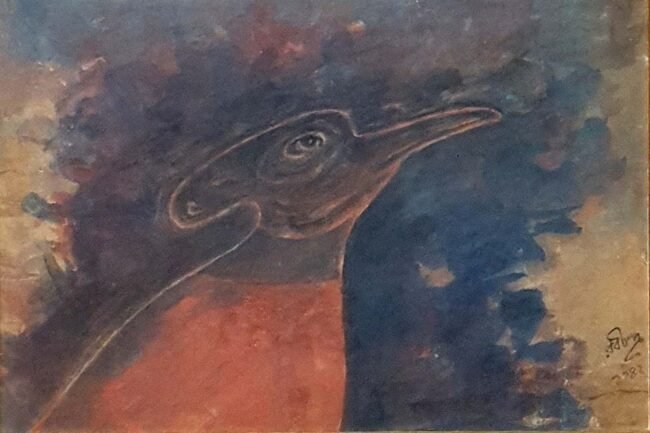
Artist: Rabindranath Tagore
Gaganendranath Tagore (1867-1938)
An innovative radical modernist, Gaganendranath Tagore introduced cubist and expressionist ideas into [Indian art]. His work evolved from caricature to abstraction. His satirical drawings and bold abstractions critiqued social hypocrisy and colonial elitism.
Gaganendranath Tagore’s experiments with Cubism-inspired geometry produced fragmented architectural spaces and abstract forms, as seen in his paintings of urban interiors and cityscapes. These works demonstrate a structural understanding of space and volume, marking one of the earliest engagements with modern European movements in Indian art-yet adapted to Indian sensibilities. With his experimental approach, he bridged tradition and modernity, making him a crucial figure in early Indian modern art.

Artist: Gaganendranath Tagore
Abanindranath Tagore (1871-1951)
A founder of the Bengal School of Art, Abanindranath Tagore played a pivotal role in reviving Indian artistic traditions during the colonial period. His delicate washes, lyrical compositions, and spiritual themes sought inspiration from Mughal, Rajput, and East Asian art.
Iconic works like Bharat Mata, Krishna Lila, and The Passing of Shah Jahan blend history, mythology, and symbolize cultural nationalism and artistic self-identity. His figures appear ethereal, floating in soft tonal atmospheres, emphasizing mood over realism. His work marks a conscious revival of Indian aesthetics in opposition to Western academic art Abanindranath’s art is meditative, symbolic, and deeply rooted in Indian philosophy, redefining the purpose of art as cultural self-expression.
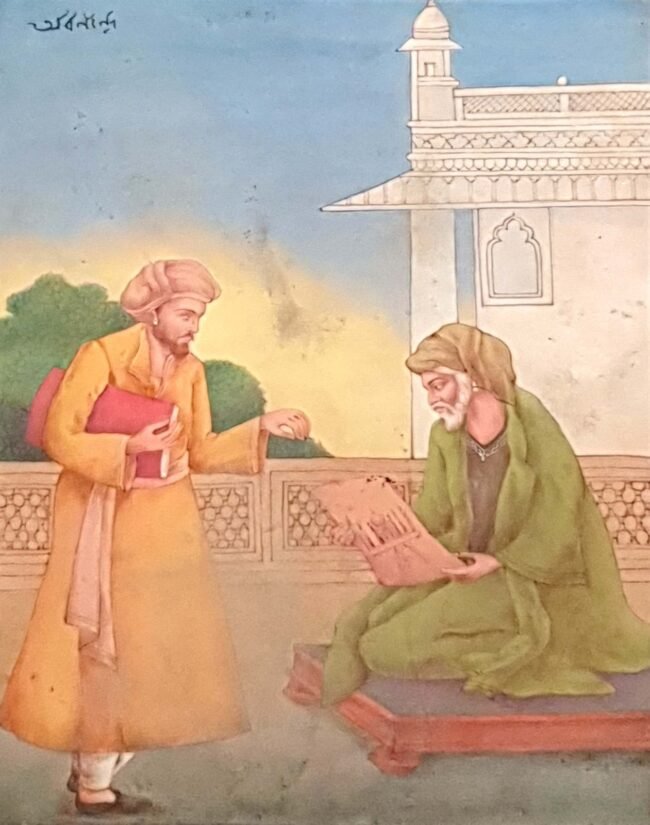
Artist: Abanindranath Tagore
J.P. Gangooly (1876-1953)
J.P. Gangooly was a distinguished Indian painter and sculptor and was known for his mastery of academic realism in portraiture and landscape art. His training under British artists and being born into extended Tagore family enabled him to blend European and naturalistic techniques with the vibrant imagery of his homeland.
J.P Gangooly was able to develop detailed and accurate artistic style, emphasising realism and careful depiction of light and colour. His exposure to Western art forms, combined with the rich traditions of Indian art helped him to evolve a unique style that resonated with both local and international audiences.

Artist: J.P Gangooly
Nandalal Bose (1882-1966)
A disciple of Abanindranath Tagore and a towering figure in Indian art education, Nandalal Bose emphasized simplicity, discipline, community engagement and Indian ethos. His murals, illustrations, and paintings draw inspiration from folk art, temple sculpture, and nature. His teaching at Santiniketan profoundly influenced generations of artists shaping modern Indian art education. His work represents a synthesis of tradition, craftsmanship, and social responsibility.
Notable works include the Haripura Posters, the Mahabharata series and murals at Santiniketan, where simplified forms and earthy colours celebrate rural life and collective spirit. His work embodies the spirit of cultural resurgence and ethical artistry.
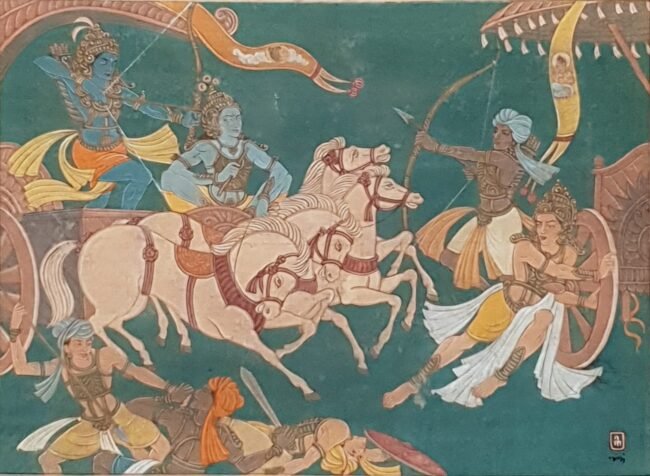
Artist: Nandalal Bose
Jamini Roy (1887-1972)
Inspired by folk art traditions such as Kalighat painting, Jamini Roy rejected Western academic styles to embrace folk traditions. His works are defined by thick black bold lines, flat vibrant colours, frontal figures, and rhythmic simplicity.
Roy’s subjects-village life, women, animals, and mythological figures like Krishna and Christ-are rendered with spiritual directness and visual clarity. By using indigenous materials and simplified forms, Roy democratized art, making it accessible and deeply connected to Indian cultural roots.
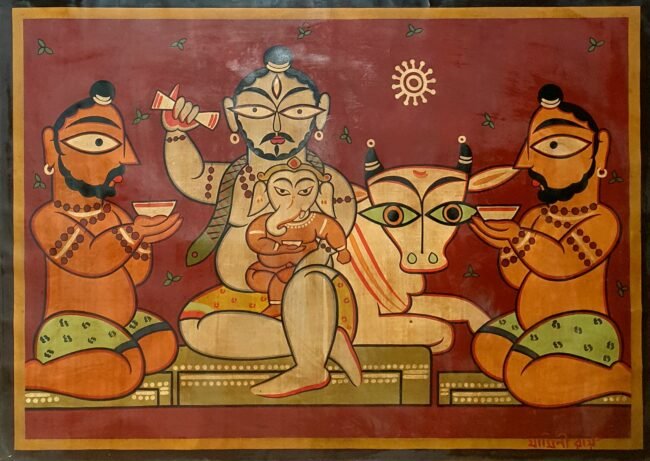
Artist: Jamini Roy
Hemen Mazumder (1894-1948)
Hemen Mazumdar was a master of academic realism, particularly in portraiture and female figures. His paintings exhibit impeccable draftsmanship, subtle modulation of light, and rich tonal depth. Unlike photographic realism, his work conveys emotional intimacy and psychological presence. He brought a refined academic sensibility to Indian painting while capturing the individuality of his subjects.
Mazumdar’s compositions often highlight texture-skin, fabric, and flesh-achieved through controlled brushwork. He bridged Western techniques with Indian subject matter, presenting modern Indian individuals with dignity and individuality.

Artist: Hemen Mazumder
Debiprasad Roy Chowdhury (1899-1975)
A distinguished sculptor and painter, Debiprasad Roy Chowdhury is best known for his monumental public sculptures. He was one of the first Indian artists to sculpt in bronze. His works combine classical Indian aesthetics with modern realism, emphasizing strength, dignity, and movement. His sculptures remain landmarks in India’s visual and cultural landscape.
Debiprasad Roy Chowdhury’s sculptural works are monumental in scale and spirit. Rooted in classical Indian sculpture, his figures emphasize anatomical strength, heroic posture, and dynamic movement. His public sculptures-such as depictions of national leaders and mythological figures-convey dignity and moral force.
He skillfully balanced realism with idealism, using simplified forms to enhance symbolic clarity. His work reflects the optimism of a newly emerging nation and remains influential in shaping public art and monumental sculpture in India.

Artist: Debiprasad Roy Chowdhury
Chintamoni Kar (1915-2005)
A leading modern sculptor, Chintamoni Kar introduced lyrical abstraction and fluidity into Indian sculpture. His works reflect movement, rhythm, and harmony, often inspired by music, dance, and human emotion. He played a vital role in shaping post-independence sculptural expression.
Using bronze and other materials, his works often suggest rather than describe the human figure, capturing motion and balance. Kar’s modernist approach opened new directions for Indian sculpture, aligning it with international abstraction while retaining lyrical sensitivity.

Sculptor: Chintamani Kar
Ganesh Pyne (1937-2013)
Ganesh Pyne’s haunting, introspective paintings explore themes of mortality, memory, and inner conflict and spiritual transcendence. Influenced by personal trauma and historical violence, his subdued palette and symbolic imagery evoke a dreamlike, often unsettling atmosphere.
His works feature skeletal figures, ghosts, birds, skulls, boats, and mythic symbols, often suspended in shallow, ambiguous spaces. Using tempera and oil with a restrained palette of blacks, blues, and muted reds, Pyne created layered surfaces that evoke silence and unease. Pyne’s work stands as a profound meditation on human vulnerability and existential anxiety.
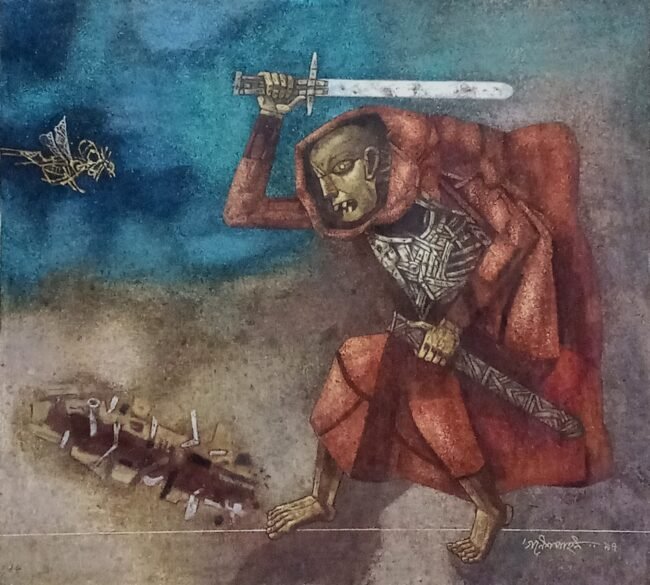
Artist: Ganesh Pyne
Together, these legendary artists represent a rich continuum of Indian art-from revivalism and nationalism to modernist experimentation and psychological depth. Their works reflect India’s cultural memory, social transformation, and enduring creative spirit, making this exhibition a vital dialogue between past and present.
The exhibition, organised by Mr Prabhas Kejariwal of Chitrakoot Art Gallery and Mr Ashatit Halder of Charulata, will be held at Chitrakoot Art Gallery from 10 February to 10 March 2026, 1pm to 7pm.
