ARTICLE WRITTEN BY DEVALEENA JOARDAR
Jamini Roy was born in a small village in Beliatore, in Bakura district of West Bengal in 1887. He joined the Government School of Art, Kolkata in 1903. With his training in a British academic system, he began his career of painting in the Post-Impressionist genre of landscapes and portraits. Under the mentorship of distinguished faculty members including Abanindranath Tagore, the founder of the Bengal School of Art and then vice-principal of the institution, Jamini Roy mastered the techniques such as classical figure drawing and oil painting on canvas, which were the hallmarks of European artistic conventions.
However, Jamini Roy gradually rejected the then modern style of painting and made his foray into the realm of Bengali folk paintings. This marked a new beginning in the history of Indian modern art. He painted on woven mats, cloth and wood coated with lime to create interesting mosaic-like surface, influenced by the texture he found in Byzantine art. He was inspired by styles such as the Kalighat Pat tradition characterized by bold, sweeping brushstrokes and simplified forms. He sought to develop an art form deeply rooted in Indian cultural heritage and identity.
Jamini Roy moved from his home in Baghbazar in North Kolkata and built a bungalow in multiple phases in Ballygunge Place, which was then a serene place with open fields. This home served as his residence and studio, where he often painted under a mango tree in the garden. Many eminent personalities such as Rabindranath Tagore, Sarojini Naidu, Indira Gandhi and Rajiv Gandhi visited his home.
Art style of Jamini Roy is typically referred to as “Neo-Bengali” art style and later evolved into a “Folk Art-inspired Modernism” or “Traditional Revivalism” or “Indian Primitivism”, characterized by its liner, decorative and colourful elements drawing heavily on local art forms such as Rural Patachitra, Kalighat Pat, clay figurines and terracotta temple structures of Bishnupur. He developed a unique artistic language, which he named as the “Flat Technique”. Instead of using commercially available colours, he prepared his own pigments using natural materials. He depended on indigenous materials, such as lampblack, chalk powder, leaves and creepers, involving a palette of seven basic colours: Indian red, yellow ochre, cadmium green, vermillion, grey, blue and white. This ensured his art was accessible to both the affluent and the common people.
Jamini Roy often sketched his compositions beforehand, refining the design before applying colour. He created multiple iterations of the same subject, making subtle adjustments to composition and colour balance in each version. Unlike Western traditional system of placing the signature in the corner, he integrated his signature in Bengali script as a seamless design element within the composition, further reinforcing his distinctive artistic identity.
Jamini Roy’s works display an array of thematic richness, reflecting his profound engagement with rural life, Hindu mythology, and Christian iconography. His work can be broadly categorized into three principal themes: the quotidian existence of rural Bengal, Hindu mythological narratives and Christian imagery.
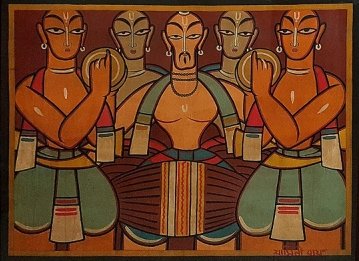
Roy’s affinity for rural Bengal reflects in his several paintings on women engaged in household chores, farmers labouring in fields; tribal community involved in harvesting, dancing and musical performances. He perfectly captured the joy and rhythm intrinsic to the Santhal culture. The works, characterized by bold, simplified forms and flat compositions influenced by Kalighat paintings, are visually striking. Roy’s fascination with the indigenous way of life is also reflected in the way he adopted the animal motifs from Indian folk-art drawing and depicted them in playful forms through his artwork.
Jamini Roy’s Mother and Child paintings typically depict a mother tenderly holding her child, rendered in bold lines, earthy colours and a style inspired by Kalighat patachitra and Bengali folk art. The simplicity of form and profound emotional depth in these paintings show his intention to celebrate the sanctity of motherhood and primal bond between a mother and her child, a timeless and universal theme.
Jamini Roy explored Hindu mythological subjects by creating iconic series like the Ramayana and Kirshna Leela. His Ramayana comprises 17 canvases and is considered a magnus opus, featuring simplified forms inspired by the Kalighat pata style. He showed epic narratives with bold lines, decorative motifs and earthy colours. His depictions of Radha-Krishna and other mythological figures conveyed a sense of divine romance and pastoral beauty.
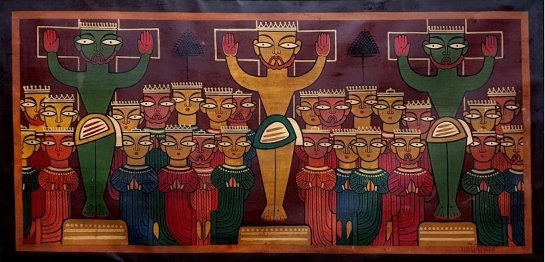
During the 1940s, Roy began on developing a compelling series centered on the life of Jesus Christ. These paintings adapted biblical stories into Indian visual traditions, portraying Christ with almond-shaped eyes and hieratic poses reminiscent of folk-art figures. Works like Crucifixion” and “Flight to Egypt” exemplify his ability to blend foreign themes with local aesthetics, imparting a uniquely Indian identity to these narratives.
Roy’s paintings of warrior Goddess Ma Durga in traditional Bengali style shows her as a powerful yet compassionate figure. His Durga paintings are also heavily influenced by Kalighat art-flat, two-dimensional forms and bold outlines. Ma Durga is mostly seen with her children Lakshmi, Saraswati, Kartik and Ganesh; or slaying the buffalo demon Mahishasura.
His another very striking piece of art is the painting of Three Pujarins engaged in a moment of devotion. It features three women depicted with bold, geometric forms, minimalistic details, and vibrant yet earthy colours, reflecting the influence of Bengali patachitra and Kalighat painting. The serene expressions and symmetrical arrangement emphasize a sense of spiritual calm and collective reverence. The artwork symbolizes the sacredness of ritual and the role of women in maintaining cultural and spiritual traditions. This also reflected the quiet strength of women in Indian society.
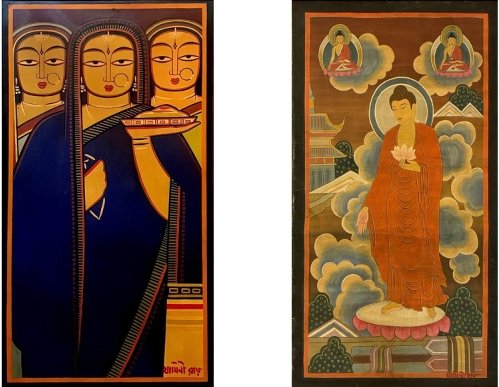
Jamini Roy portrays women in simple yet elegant forms, often wearing sarees or other regional garments, with their expressions and postures conveying a quiet strength and poise.
Roy’s Black Horse paintings represent strength, vitality and elegance. Horse and Rider paintings depict a powerful and dynamic relationship between the rider and the horse. While the horse symbolizes strength and vitality, the rider represents control and direction. Together it conveys themes of harmony, power and determination. It beautifully captures the essence of movement and the bond between man and nature. It celebrated rural and agrarian life where horses were integral to both work and culture.
His other popular works include Lady with Flute paintings, Woman with a Pot paintings, Man with a Bull paintings, Peacock paintings, Gopis and Apsaras paintings, Krishna with Gopis paintings, Ganesh paintings, Cat and the Lobster paintings, Patua-style paintings, and so on.
Jamini Roy’s legacy and influence on Indian art are profound and enduring, marking him as a crucial figure in the history of modern art. His effect can be observed across multiple dimensions. He portrayed the richness of Indian heritage and encouraged artists to explore their cultural roots. Indigenous modernism inspired the Bengal School movement and later artists like K.G. Subramanyam and A. Ramachandran. His deliberate attempt to turn towards indigenous aesthetics represented cultural resistance against colonial influences. His work bolstered the swadeshi movement in art, encouraging Indian artists to develop visual languages reflective of their own traditions rather than imported European styles.
Jamini Roy produced around 20,000 paintings in his lifetime. He believed that the ordinary people were the voice of his art and targeted the ordinary middle class as the upholder of art. He would even buy back his paintings if he found out that his paintings were not being well-maintained by the buyers. He preferred to be called a “patua” reflecting his deep connection. with traditional folk art forms and his role as a storyteller through his paintings. Roy reflected a broader cultural awakening among artists to reclaim their heritage. Though he had financial struggles, he remained committed to his artistic vision, prioritizing cultural authenticity over financial gain. Jamini Roy involved his family in his artistic pursuit, often turning them into a production unit, and emulating a craft-guild mode of artistic production.
His house in Ballygunge Place, Kolkata, where he lived until his death in 1972, has been declared a heritage site and continues to be an important landmark for passionate artists and art lovers. In 2017, Google celebrated his birthday a special doodle.
Jamini Roy was awarded the Viceroy’s Gold Medal in an All-India exhibition for one of his works in 1934 or 1935 for ‘Mother Helping the Child to Cross the Pool’. In 1954, he was conferred the Padma Bhushan by the Government of India, the nation’s third highest civilian honour, acknowledging his significant contributions to Indian art. In 1955, Jamini Roy was awarded an honorary D.Litt by Visva Bharati University, a prestigious institution founded by the Nobel laureate Rabindranath Tagore. In 1976, the Archaeological Survey of India posthumously declared Jamini Roy’s works among the “Nine Masters” whose art was considered “national treasures” and prohibited from export outside India under the Antiquities Art Treasures Act. In 1978, the Government of India issued a commemorative stamp featuring Roy’s works and his contributions to Indian art.
A book on Jamini Roy titled Jamini Roy-Retracing the Lines, dedicated to Debabrata Roy has been published by Prabhas Kejariwal for Chitrakoot Art Gallery in October 2019. The book has been edited by Caterina Corni and Prakash Kejariwal. The book has two sections-text sections and artwork sections. Well-known artists and art critics, such as Debabrata Roy, Adriana Mazza, Caterina Corni, Nirmalya Kumar, Austin Coates, Prasanta Daw and Pranab Ranjan Roy have contributed towards the written section. The collection of art works presented in the book represent an interesting array of paintings and sketches by Jamini Roy, and has been collected from various authentic sources.
CHITRAKOOT ART GALLERY has been established by DR PRAKASH KEJARIWAL in 1985. It is one of the pioneers and most prestigious galleries of Kolkata. He studied in esteemed universities-Presidency College (1957-1960) and Jadavpur University (class of 1963). He taught in Jadavpur University for 23 years (1967-1990).
MR PRABHAS KEJARIWAL of CHITRAKOOT ART GALLERY and MR ASHATIT HALDER of CHARULATA are jointly holding an exhibition of the works of JAMINI ROY titled “THE SIGNIFICANT WORKS OF JAMINI ROY” at CHITRAKOOT ART GALLERY from 1 PM to 7 PM from 15 MAY to 15 JUNE, 2026.